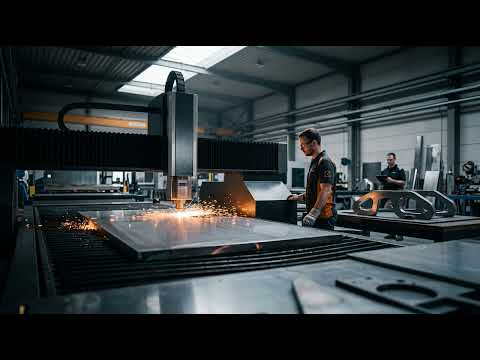
Kern Laser Systems manufactures high-performance laser cutting and engraving equipment specifically engineered for commercial signage production. Founded in 1982, the company provides turnkey solutions that handle the diverse material requirements of the modern sign industry. This guide covers the specific material capabilities of these systems and details the available laser system formats for your facility.
Choosing between CO2 and fiber laser cutting machines depends primarily on your target materials and production goals. Fiber lasers excel at high-speed metal fabrication, while CO2 lasers offer superior versatility for mixed-material environments. This guide provides a detailed breakdown of edge quality, maintenance, and operational costs to help you make the right capital investment decision.
Evaluating a fiber laser cutting system requires matching laser power, assist gas capabilities, and material compatibility to your specific production goals. This guide provides a structured framework for assessing these critical factors to ensure your investment maximizes throughput and profitability. We will cover power selection, gas economics, automation, and service infrastructure to help you make an informed decision .
Industrial laser safety protocols are necessary to prevent severe eye and skin injuries, fires, and equipment damage. These protocols include strict access controls, proper ventilation, and mandatory personal protective equipment. This guide covers the essential safety measures required for operating industrial laser equipment, focusing on lockout/tagout procedures and compliance with industry standards.
CO2 lasers deliver unmatched speed, edge quality, and material versatility for high-volume acrylic production. Kern Lasers designs these systems to handle continuous production schedules while maintaining the precision required for commercial signage and awards. This guide explores the specific operational advantages that make CO2 technology the industry standard for acrylic processing.
Optical cleaning frequency depends on material type, usage hours, and environmental dust levels. For most industrial CO2 and fiber laser systems, inspecting and cleaning optics daily or after every 8 to 12 hours of operation is the standard best practice. Consistent maintenance prevents beam degradation, protects expensive lenses, and ensures cut quality remains consistent across production runs.
For metal signs and nameplates, a fiber laser cutter is the primary choice for most manufacturers. It offers the speed and precision required for thin sheet metals like stainless steel, aluminum, and brass. This guide covers the specific laser technologies, material capabilities, and operational considerations for producing high-quality metal identification products.
For many beginners, a Glowforge is a strong entry point because it simplifies setup and operation. However, it is a diode laser with specific material limitations. If your primary goal is cutting thick acrylic or metal, a CO2 or fiber laser from a manufacturer like Kern Laser Systems may be a better long-term investment. The right choice depends on your specific materials and production goals.
For a shop with limited space, the best small laser cutter is a compact, high-power CO2 system like the Kern MICRO. It delivers industrial-grade precision in a small footprint without sacrificing output. This guide covers how to select the right compact machine, manage safety in tight quarters, and maximize workflow efficiency.
For high-volume production, the best laser cutting system is a high-power fiber laser integrated with automated material handling and advanced nesting software. This combination maximizes throughput, minimizes downtime, and ensures consistent cut quality across thousands of parts. This guide explores the critical components of a high-volume laser setup, including automation, power requirements, and material handling strategies. We will examine how these elements work together to create an efficient manufacturing workflow.
Industrial manufacturing is undergoing a rapid transformation driven by the need for speed, precision, and material versatility. According to recent market analysis, the global industrial laser market is projected to exceed $15 billion by 2028, with high-wattage systems (>10kW) capturing the largest share of growth. This surge is not merely a trend but a necessity for sectors like aerospace, heavy machinery, and automotive production where thick-gauge metal cutting demands immense thermal energy. Understanding the critical features of these systems is essential for maximizing return on investment and ensuring operational safety.